简介
解析生物如何适应复杂环境是生物学研究的核心任务之一。黑腹果蝇(Drosophila melanogaster)和拟果蝇(Drosophila simulans)为姊妹种,均起源于非洲,在近期扩散到世界各地,是研究环境适应遗传和进化机制的理想材料。
本项目旨在通过比较群体基因组学,阐明果蝇自然群体环境适应的分子机制和演化规律。研究内容主要包括:解析果蝇适应复杂自然环境(例如饥饿、温度、杀虫剂等常见环境压力)的遗传架构,并进行功能解析与验证;重建黑腹果蝇和拟果蝇全球范围的迁移进化历史,揭示进化历史与环境适应的关联;阐明黑腹果蝇和拟果蝇环境适应机制的共同规律及物种特异性适应机制。
果蝇的演化历史和环境适应机制
环境适应的遗传机制是演化生物学中的重要问题,但自然群体中适应的分子机制和遗传规律还存在很多未解决的难题。黑腹果蝇是重要的模式生物,起源于热带非洲,在近期扩散到世界各地,为系统的研究环境适应的遗传机制提供了很好的材料。然而,以往研究多集中在欧洲、北美和非洲群体,对亚洲地区的果蝇缺乏了解,该物种的自然群体在全球尺度的演化历史和适应不同环境的遗传机制尚不清楚。本项目通过野外采样和测序获得了中国各地的黑腹果蝇和拟果蝇基因组,利用群体基因组学分析,系统揭示果蝇的群体遗传结构、群体间基因流、群体分歧历史和自然选择信号,并结合群体箱实验验证自然群体中的正选择信号与环境选择压力之间的关系。
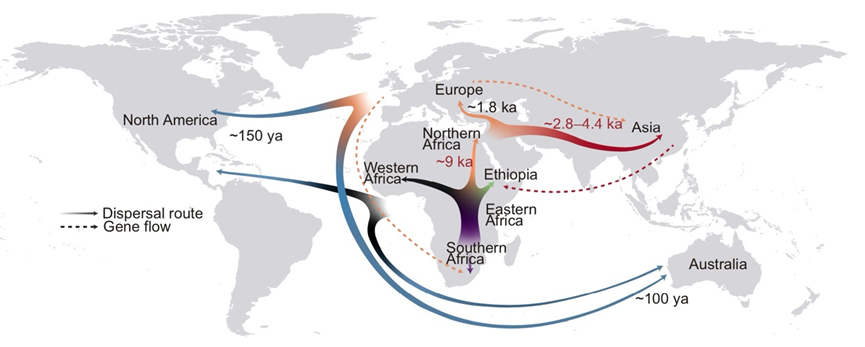
黑腹果蝇的迁移扩散历史
黑腹果蝇饥饿抗性相关基因的性别冲突
尽管雌雄两性共享绝大部分基因组,但它们在生理结构、激素环境、繁殖策略等诸多方面仍存在显著差异。同一遗传变异可能对两性产生不同的适合度效应,例如仅影响单一性别(性别特异)、对某一性别影响更强(性别偏向),甚至对一性有益而对另一性有害(性别冲突)等。除遗传因素外,环境变化也可能对两性适合度产生差异化影响。本项目通过饥饿耐受这一与环境适应紧密相关的表型,使用群体箱对中国不同地点采集的黑腹果蝇品系开展了统一的表型筛选与混池测序。研究系统鉴定了与饥饿耐受相关的遗传变异,揭示了调控区域和蛋白质序列变化在饥饿耐受遗传架构中的作用,并结合RNA干扰和CRISPR/Cas9对候选基因进行了功能验证,发现约74%的候选基因表现出性别依赖的表型效应,其中12个基因还存在性别冲突的表型效应。该研究成果为理解适合度相关性状的基因型-表型关联、以及遗传背景、性别差异与基因多效性在性状演化中的作用提供了新视角。
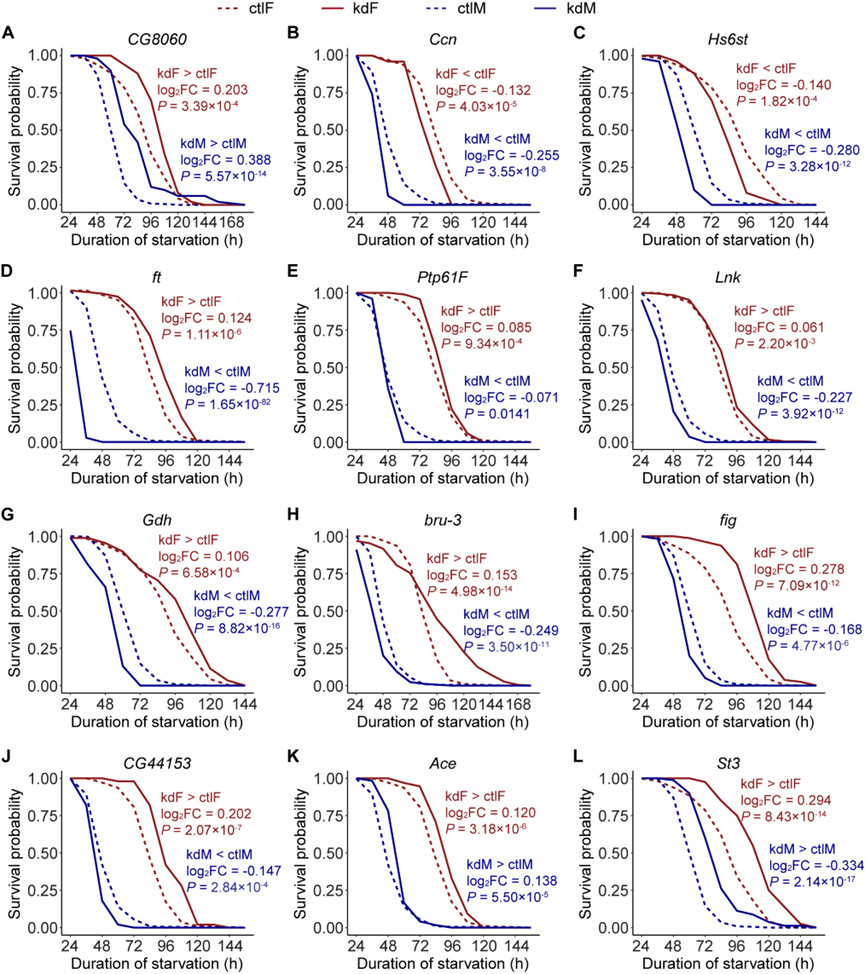
RNA干扰实验验证饥饿耐受候选基因的表型效应
高质量果蝇基因组
本项目对拟果蝇w501(Drosophila simulans w501)品系雄性个体进行了高深度测序。结合PacBio HiFi、ONT、Hi-C等测序结果,组装得到了拟果蝇的高质量基因组,基因组总长度为156.08 Mb,由28个支架序列组成,N50长度为53.73 Mb。拟果蝇基因组包含4条主要的支架序列,分别对应4条主要的染色体。其中,2号(chr2)、3号(chr3)和4号(chr4)染色体长度分别为53.73 Mb、59.32 Mb和1.16 Mb,X染色体(chrX)的长度为23.74 Mb。此外,该基因组还包含了长度为18,473 bp的环状线粒体基因组(chrM)和23个未定位到染色体上的重叠群。其中有13个Y连锁重叠群,总长度为12.64 Mb。拟果蝇基因组中重复序列占比31.54%(49.22 Mb),大部分重复序列位于端粒和着丝粒区域。
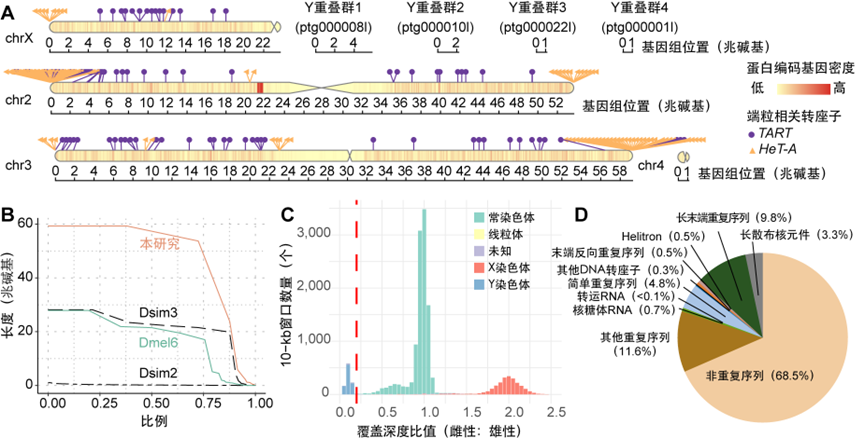
拟果蝇基因组
近缘物种环境适应的趋同
生物演化是否具有可重复性,是生物学中的一个核心问题。自然选择,作为演化的一种重要驱动力,在生物适应环境的过程中起着至关重要的作用。自然选择介导的适应性趋同演化是探索演化的可重复性的一个有效途径。本项目以近缘物种黑腹果蝇与拟果蝇为研究对象,基于两者在生物学特征、亲缘关系、全球分布模式和迁移历史等方面的相似性,开展全球自然群体的大规模比较基因组学研究,旨在揭示生物适应复杂自然环境的遗传架构,并进一步探索近缘物种环境适应的普适规律和可重复性。通过采集测序和收集整理,项目共获得包含了来自11个拟果蝇群体的681个基因组和22个黑腹果蝇群体的1,335个基因组,分析揭示了拟果蝇与黑腹果蝇在群体结构和演化历史上的相似性。研究结合多种方法从不同时间尺度检测了自然选择信号,发现约9%–14%的基因在物种间发生了适应性趋同演化,趋同常常发生在基因和通路水平而不是位点水平。研究为理解生物的环境适应机制和演化的可重复性提供了新的见解。
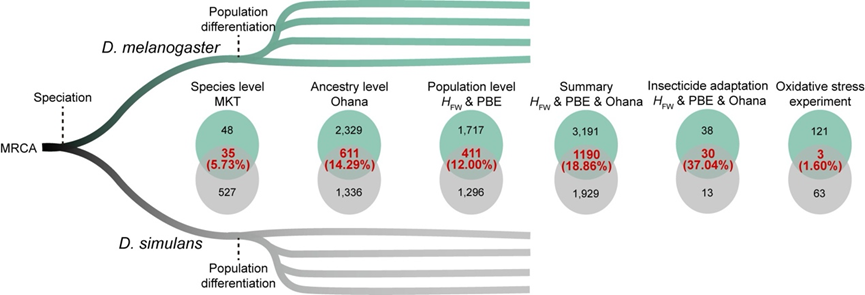
拟果蝇和黑腹果蝇在演化时间尺度上的适应性趋同
Introduction
Understanding how organisms adapt to complex environments is a core task of biological research. Drosophila melanogaster and Drosophila simulans are sister species, both originating from Africa and recently spreading worldwide. They serve as ideal models for studying the genetic and evolutionary mechanisms of environmental adaptation.
This project aims to elucidate the molecular mechanisms and evolutionary patterns of environmental adaptation in Drosophila natural populations through comparative population genomics. The research mainly includes: analyzing the genetic architecture of Drosophila adaptation to complex natural environments (e.g., starvation, temperature, insecticides, and other common environmental stressors) and performing functional verification; reconstructing the global migration and evolutionary history of D. melanogaster and D. simulans to reveal the association between evolutionary history and environmental adaptation; and clarifying the common laws and species-specific mechanisms of environmental adaptation in these two species.
Evolutionary History and Environmental Adaptation Mechanisms of Drosophila
The genetic mechanism of environmental adaptation is a crucial issue in evolutionary biology, but many unsolved problems remain regarding molecular mechanisms and genetic laws in natural populations. Drosophila melanogaster is an important model organism, originating from tropical Africa and recently spreading to various parts of the world, providing excellent material for systematically studying the genetic mechanisms of adaptation. However, previous studies have mostly focused on European, North American, and African populations, with a lack of understanding of Drosophila in Asian regions. The evolutionary history of natural populations on a global scale and the genetic mechanisms of adapting to different environments remain unclear. This project obtained genomes of D. melanogaster and D. simulans from various locations in China through field sampling and sequencing. Using population genomics analysis, we systematically revealed the population genetic structure, gene flow between populations, divergence history, and natural selection signals. We also combined population cage experiments to verify the relationship between positive selection signals in natural populations and environmental selection pressures.
Migration and Diffusion History of D. melanogaster
Sexual Conflict in Starvation Resistance Genes of D. melanogaster
Although males and females share most of the genome, significant differences exist in physiological structure, hormonal environment, reproductive strategies, and more. The same genetic variation may produce different fitness effects on the two sexes, such as affecting only one sex (sex-specific), affecting one sex more strongly (sex-biased), or even being beneficial to one sex while harmful to the other (sexual conflict). In addition to genetic factors, environmental changes may also have differential impacts on the fitness of both sexes. This project conducted unified phenotypic screening and pool-seq on D. melanogaster strains collected from different locations in China using population cages, focusing on starvation tolerance—a phenotype closely related to environmental adaptation. The study systematically identified genetic variations associated with starvation tolerance, revealing the roles of regulatory regions and protein sequence changes in the genetic architecture of starvation tolerance. Combined with RNA interference and CRISPR/Cas9 for functional verification of candidate genes, we found that about 74% of candidate genes showed sex-dependent phenotypic effects, among which 12 genes exhibited sexually conflicting phenotypic effects. These results provide new perspectives for understanding the genotype-phenotype association of fitness-related traits, as well as the roles of genetic background, sex differences, and pleiotropy in trait evolution.
Phenotypic Effects of Candidate Genes Verified by RNA Interference
High-Quality Drosophila Genome Assembly
This project performed high-depth sequencing on male individuals of the Drosophila simulans w501 strain. Combining PacBio HiFi, ONT, Hi-C, and other sequencing results, a high-quality genome of D. simulans was assembled. The total genome length is 156.08 Mb, consisting of 28 scaffolds, with a scaffold N50 of 53.73 Mb. The D. simulans genome contains 4 main scaffolds corresponding to the 4 main chromosomes. Specifically, the lengths of chromosome 2 (chr2), chromosome 3 (chr3), and chromosome 4 (chr4) are 53.73 Mb, 59.32 Mb, and 1.16 Mb, respectively, while the X chromosome (chrX) is 23.74 Mb. In addition, the genome includes a circular mitochondrial genome (chrM) of 18,473 bp and 23 unplaced contigs. Among them, there are 13 Y-linked contigs with a total length of 12.64 Mb. Repetitive sequences account for 31.54% (49.22 Mb) of the genome, mostly located in telomeric and centromeric regions.
Drosophila simulans Genome Assembly
Adaptive Convergence in Closely Related Species
Whether biological evolution is repeatable is a core question in biology. Natural selection, as a key driving force of evolution, plays a vital role in the process of organisms adapting to the environment. Adaptive convergent evolution mediated by natural selection is an effective way to explore the repeatability of evolution. This project took closely related species D. melanogaster and D. simulans as research objects. Based on their similarities in biological characteristics, phylogenetic relationship, global distribution patterns, and migration history, we conducted a large-scale comparative genomics study of global natural populations to reveal the genetic architecture of biological adaptation to complex natural environments and further explore the universal laws and repeatability of environmental adaptation in related species. Through sampling, sequencing, and data collection, the project obtained 681 genomes from 11 D. simulans populations and 1,335 genomes from 22 D. melanogaster populations. Analysis revealed similarities in population structure and evolutionary history between the two species. Combining multiple methods to detect natural selection signals at different time scales, the study found that about 9%–14% of genes underwent adaptive convergent evolution between species, and convergence often occurred at the gene and pathway levels rather than at the site level. This study provides new insights into understanding the mechanisms of environmental adaptation and the repeatability of evolution.
Adaptive Convergence in D. simulans and D. melanogaster